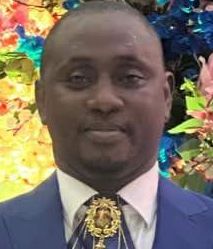

TMoney, as fondly called in the cartel of fraudsters, was a notorious and famous advanced fees fraudster (commonly called Yahoo Yahoo in local parlance) in the Agege area of Lagos and extended to some suburbs in Ogun State.
At a very young age in his early 20s, he lived a wild life: clubbing, drinking, womanising, and living in opulence from the ill-gotten proceeds of hundreds of millions from advanced fees fraud crimes until one particular case of such crime led him to stab himself with a sharp knife to commit suicide over his implication in the crime.
But God intervened, saved him, and turned his life around from a fraud kingpin to a prophet and currently the Parish Pastor of the Redeemed Christian Church of God (RCCG) Grace Court, Agege, Lagos, now as Pastor Temitayo Olatunji Oluwaseyi.
In this account of his Rebirth Encounter, Pastor Temitayo shares his journey from crime to Christ in the below interview with Christian Benefits magazine.
*How would you like to be introduced?*
Under the umbrella of the Redeemed Christian Church of God (RCCG), I am a pastor. By divine calling, I am also a prophet. Therefore, I am Prophet Temitayo Olatunji Oluwaseyi.
*Briefly share with us about your background and upbringing*
I was raised in a polygamous family. My father, Adewale Olatunji, was a mechanical engineer who worked with SCOA Motors. He had five wives, and my mother was the second wife. Altogether, we were sixteen siblings.
Growing up was very difficult. In 2000, I left home and moved to the streets of Lagos to struggle for survival. During that period, I learned several vocational skills, including barbing and catering.
I worked as a barber at Allen Avenue, Lagos, where I attended to notable personalities and footballers such as Jonathan Akpoborie, Sunday Oliseh, and Victor Ikpeba, among others. I worked at Lady Top Barbing Salon, Hilton Bus Stop, off Allen Avenue, for about a year.
Thereafter, in 2001, I worked with Landover Aviation Company in conjunction with DHL. Along the way, I realized that I needed to acquire more skills, so a friend introduced me to a confectionery outfit where I began working as a chef. There, I learned how to prepare Chinese cuisine and other continental dishes. I left the confectionery in 2002.
During that period, I became fascinated by the flamboyant lifestyle of Yahoo boys (internet fraudsters), many of whom I had served as a chef. Eventually, I joined them in fraudulent activities. I ended up living that lifestyle for about sixteen years, moving from one hotel to another.
During those years, I had two children from two different women. It was a rough and lonely life. I had virtually no close family member around me throughout that period and gradually became an outcast.
In 2019, I became involved in a transaction with some young men that attracted the attention of the EFCC, DSS, the Police, and even cult guys. The transaction went badly, and everyone involved became targets of investigations and manhunts by both security agencies and criminal elements.
Some cultists traced me to my father’s house. When they were told that I had left home many years earlier, they allegedly pointed a gun at my father’s head and demanded that he produce me. They threatened severe consequences if he failed to do so within a specified period.
*Can you share with us specifically what this transaction was about?*
It was essentially a financial transaction involving myself and some young men who later accused me of taking a larger share of the proceeds than they believed I deserved.
Today, I thank God for preserving my life. Back then, I was deeply involved in internet fraud. There was virtually nothing I could not do online. If given a payment slip, I could trace transactions and investigate financial movements. I was a notorious Yahoo boy in Lagos.
The young men involved in the deal sent me payment documents to help track funds. After some time, they believed I had successfully traced and recovered the money, whereas the owner of the funds had already moved them to another account. The transaction involved funds transfered from South Africa.
When the deal collapsed, the situation became chaotic. The young men accused me of swindling them and began threatening me. I reported the matter at Ajuwon Police Station, maintaining that I had not received any money from the transaction.
The case became so serious that senior police authorities became aware of it. At one point, the then Inspector-General of Police was said to have been briefed about the matter. The South African parties involved reportedly escalated the issue, leading to the involvement of the EFCC and other security agencies.
As a result, the EFCC was searching for me, the DSS was searching for me, and cultists were also looking for me. Many of these cultists were people I had known from my days on the streets. They frequently called me, saying, “T-Money”—which was my street name—”you must come out and answer for this matter.”
This happened in February 2019, shortly before the presidential election. Reports circulated online alleging that I had stolen ₦34 million, and security agencies were looking for me.
Fortunately, because of the election season and the overwhelming political activities at the time, the story did not gain wider public attention.
My father eventually called me and told me that armed men had threatened him and even vowed to sell his house if he failed to produce me.
At that point, I decided to come out of hiding. Some of the people linked to the transaction, including individuals known as Kowope and Ajikawo, had already suffered brutal attacks from cultists who were demanding the recovery of about ₦50 million.
When they discovered that I was staying in a hotel in Akute, they invaded the premises, shattered windows, destroyed parts of the hotel bar, and searched for me. Fortunately, I escaped before they found me.
Later, my elder brother invited me to his house. Even before these events, I had already become tired of the life I was living and had begun considering a different path.
The money involved in the transaction did not belong to me. I was only acting as a middleman. My intention was to collect my agreed commission and use it as a stepping stone to begin a new life. However, I later realized that such money could never be God’s means of giving me a fresh start.
That night, around midnight, while at my brother’s house, I became overwhelmed with guilt and despair. I could not bear the thought that people were being threatened, assaulted, and having their properties destroyed because of me. My house in Akute had been vandalized. The hotel where I stayed had been attacked. A police officer had reportedly been punished because of issues connected to my case.
At that moment, I decided to end my life. I took a knife and stabbed myself in the stomach.
To my surprise, I did not die.
My brother rushed me to several hospitals around Ajuwon that night, but they all declined to treat me because the knife remained lodged in my stomach. I could barely speak throughout the night.
Eventually, I was taken to Lagos State University Teaching Hospital (LASUTH), Ikeja, but due to the severity of my condition, I was referred elsewhere. From there, I was moved to Lagos University Teaching Hospital (LUTH), where I was initially told there was no available space.
However, a consultant who saw my condition remarked that I still had a chance of survival and insisted that I be admitted.
Arrangements were made for me to receive immediate attention.
Medical personnel conducted several tests and scans. They discovered that my bladder had ruptured. By then, almost everyone around me had abandoned me, including many people I had once helped.
The knife remained lodged in my stomach until the following day. Eventually, doctors carried out a major operation and transferred me to the ward for recovery.
That experience marked a turning point in my life and set me on the path that eventually led me to Christ and the prophetic ministry.
(To be concluded)