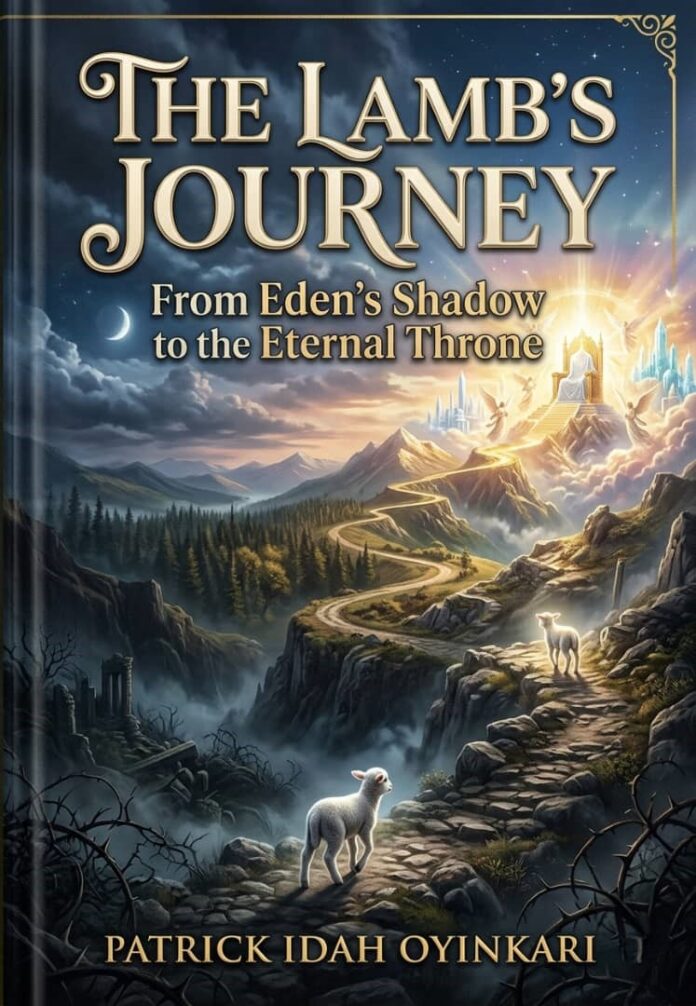


Book Review: The Lamb’s Journey: From Eden’s Shadow to the Eternal Throne
Author: Patrick Idah Oyinkari
Publisher: Mikro
Publishers, 2026
Reviewer: Dr. Wole Olarinde
Patrick Idah Oyinkari’s The Lamb’s Journey: From Eden’s Shadow to the Eternal Throne is a masterful theological exposition that invites readers to trace the profound and intricately timed journey of the Lamb of God, from the Garden of Eden to the ultimate Throne of Glory in Revelation.
This work distinguishes itself by its meticulous attention to biblical chronology, typology, and the overarching narrative of redemption, providing a fresh perspective that challenges traditional interpretations.
The book is structured into five parts, guiding the reader from the shadow of the first covering in Eden, through the sacrificial precision of the Passover, to the Lamb’s resurrection and eternal reign. Oyinkari begins with Genesis 3, highlighting the first act of substitutionary grace when God clothed Adam and Eve with skins—a symbolic foreshadowing of Christ’s ultimate sacrifice. He carefully illustrates how human attempts at self-justification, represented by fig leaves, are insufficient without divine intervention, establishing the Lamb as the central thread of redemptive history.
A standout feature of the book is its insistence on precision in the biblical timeline, particularly the Wednesday crucifixion and the literal three days and three nights in the tomb, what Oyinkari calls the “Sign of Jonah.” He traces the Lamb’s journey against the backdrop of the Hebrew calendar, emphasizing the divine rhythm embedded in Sabbath observance, Passover feasts, and appointed sacrifices. Chapters detailing the selection, inspection, and presentation of the Lamb (Nisan 10 to Nisan 14) are deeply rooted in scriptural exegesis, providing readers with both a theological and legal perspective on Christ’s sacrifice.
The book does not merely recount events; it systematically unpacks the legal, prophetic, and spiritual implications of the Lamb’s journey. Oyinkari’s analysis of events such as the foot washing, the Upper Room meal, and the resurrection demonstrates how every detail, down to the timing of hours and Sabbaths, points to God’s sovereign plan. Part IV and V extend this trajectory into eschatological fulfillment, describing the Lamb as the eternal Sovereign in Revelation and highlighting the Marriage Supper and the River of Life as the culmination of redemptive history.
Oyinkari’s prose is both reverent and instructive. He balances scholarly rigor with accessibility, making the book suitable for ministers, theology students, and lay readers who wish to deepen their understanding of biblical typology and God’s redemptive timeline. His repeated “second look” sections throughout each chapter serve as helpful reflections, allowing the reader to pause, review, and internalize key insights.
In essence, The Lamb’s Journey is more than a commentary; it is a map of salvation history. Oyinkari challenges readers to reconsider long-held assumptions, urging them to see beyond tradition to the precise orchestration of God’s plan. It is a book that educates, inspires, and draws the reader into a contemplative engagement with Scripture, revealing the Lamb’s journey not only as historical but as eternally relevant.
Recommendation: This book is highly recommended for anyone seeking a deeper, chronologically precise, and spiritually enriching understanding of the life, death, resurrection, and sovereignty of Christ as the Lamb of God.