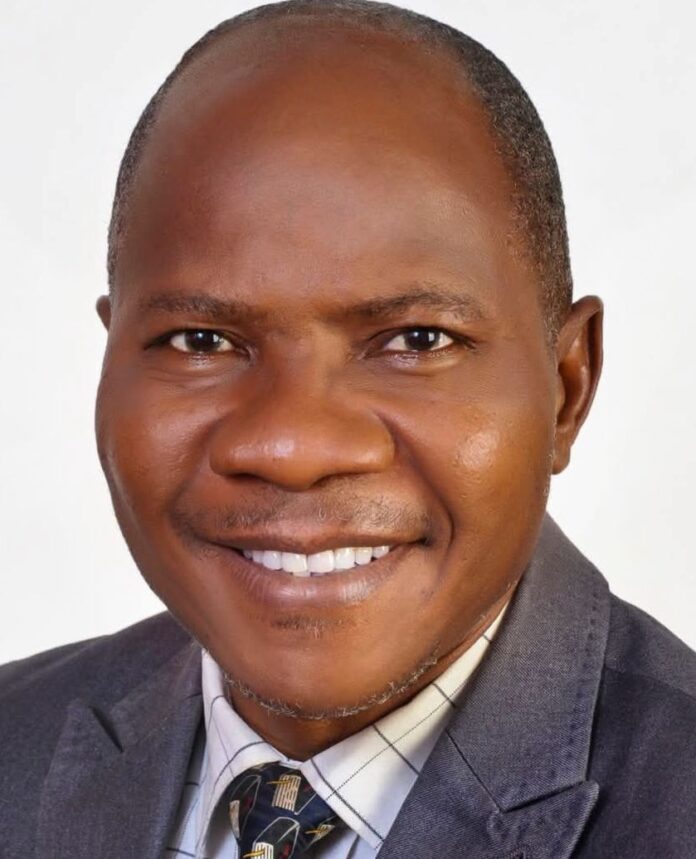

The General Overseer of Gospel Flame Worship Assembly, Dr. David Ikhielea, has admonished fellow ministers of the gospel that it is a misconception to rely solely on the Holy Spirit in ministry without acquiring sound theological training.
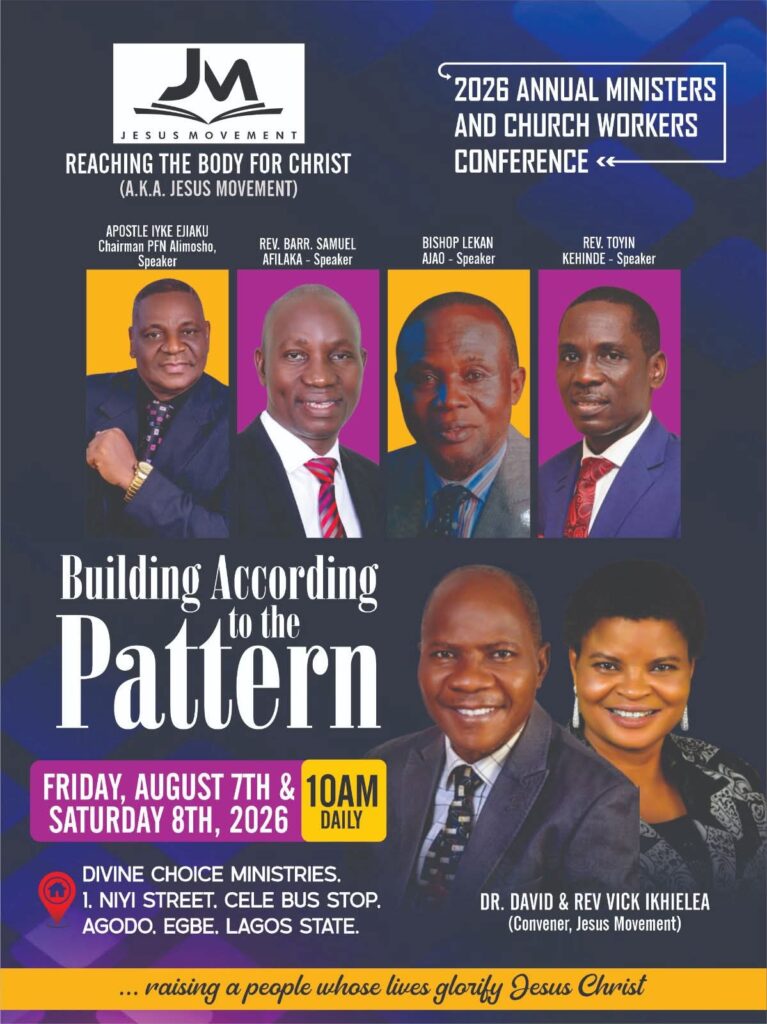
In this exclusive interview with Christian Benefits Magazine ahead of the 2026 Annual Ministers and Church Workers Conference holding from August 7-8, 2026 in Lagos, being organised by Reaching the Body For Christ (a.k.a Jesus Movement), Dr. Ikhielea, who is also the Convener of the movement, recounts his remarkable journey from being a cult member while studying at the Institute of Management and Technology (IMT), Enugu, to becoming a committed Christian, pursuing a successful career as a senior staff member of Nigeria Reinsurance Corporation, and voluntarily retiring in 1994 to answer God’s call into full-time ministry.
He also explains how he later abandoned plans to pursue a Master’s degree in Law after God redirected him toward theological education, culminating in a doctorate in theology. According to him, the turning point in his ministry came through a profound encounter in which God taught him the necessity of dying to self completely in order to serve Him faithfully. Dr. Ikhielea also shares his concerns about the current state of the Church in Nigeria and the burden God has placed on his heart for the Body of Christ in the below interview with Christian Benefits Magazine. Excerpts:
For starters, please, can you tell us about your background and your salvation experience?
I became a Christian while I was an undergraduate at the Institute of Management and Technology (IMT), Enugu. Before my conversion, I belonged to one of the cult groups on campus. However, the Lord saved me and later used me to preach against cultism, not only at IMT but also on several other campuses across Nigeria until I graduated.
Before gaining admission to IMT, I was already working with Nigeria Reinsurance Corporation. I proceeded on study leave to study Insurance at IMT. After graduating, I enrolled in the Law programme at the National Open University of Nigeria (NOUN) as one of the pioneer students in the Department of Law.
I later planned to pursue a Master’s degree in Law and had already obtained the admission forms from Lagos State University (LASU). However, it suddenly dawned on me that I did not really need a Master’s degree in Law. I had already voluntarily retired from the Nigeria Reinsurance Corporation in 1994 to answer God’s call into full-time ministry. I therefore asked myself what practical purpose the degree would serve in fulfilling my calling. By the grace of God, I have been in full-time ministry since 1994. I am happily married to Rev. Mrs. Victoria Ikhedia, and God has blessed us with five children.
In the first place, why did you voluntarily retire from a thriving career to answer God’s call, and why did you later abandon your plan to pursue a Master’s degree in Law?
I voluntarily retired in order to answer God’s call upon my life. While making plans to pursue a Master’s degree in Law, I suddenly asked myself, What am I going to do with this degree? Am I going to practise law? My intention was simply to study Law for personal development. Then I reasoned that it would be better to pursue studies that would directly enhance the ministry God had called me into.
At the time, I was serving as the Chairman of the Alimosho Province of the Pentecostal Fellowship of Nigeria (PFN), Lagos State Chapter. Representatives of West Africa Theological Seminary (WATS) regularly visited our meetings to introduce the seminary’s programmes. One of them encouraged me to enrol for theological studies to strengthen my calling and ministry. There is a widespread misconception among some Christians that pastors who are genuinely called by God do not need theological education because they already have the Holy Spirit. Yet many who hold this view do not even allow the Holy Spirit to guide them as they should.
Interestingly, I once held the same opinion. While I was in the Foursquare Gospel Church, I eventually attended Life Theological Seminary of The Fousrsquare Organization then at No. 62 Akinwunmi Street, Yaba, Lagos. I also attended All Nations Bible School of Church of God Mission (CGM) on Airport Road, Mafoluku, Lagos. Therefore, instead of pursuing a Master’s degree in Law at LASU, I decided to enrol at West Africa Theological Seminary (WATS), where I obtained a Master of Divinity (M.Div.) degree. By the grace of God, I later earned my doctoral degree there as well. It was an academic doctorate, not an honorary degree.
Specifically, what is the mandate of your ministry?
Until 1998, I did not clearly understand the specific mandate God had given me. All I knew was that, while I was still working at Nigeria Reinsurance Corporation, I gradually lost every sense of fulfilment in my job. Instead, I began to experience a deep, heavenly burden in my heart to give myself completely to the work of God.
Nigeria Reinsurance was a federal parastatal. By the grace of God, we were well remunerated. As senior staff members, we enjoyed good salaries and additional benefits, including meal vouchers. Humanly speaking, I was comfortable and had every reason to remain in my career. Yet, the burden to serve God full-time kept growing stronger.
At the time, I was in courtship with my fiancée, who is now my wife. I shared my growing dissatisfaction with my job and the burden I felt to enter full-time ministry. She encouraged me, reminding me that “in Him we live and move and have our being.” She also said that even if I was not yet certain of a specific calling, every believer already has the Great Commission: “Go into all the world and preach the gospel.” Her words strengthened my resolve to obey God.
Afterwards, I went to the Redemption Camp for several days of fasting and prayer. One evening, Pastor E. A. Adeboye was ministering and began sharing how he entered full-time ministry. As he spoke, I became convinced that God was speaking directly to me through him, confirming the decision already forming in my heart.
When I returned from the retreat, I submitted my three-month notice of voluntary retirement to Nigeria Reinsurance Corporation in 1994. Even before leaving my job, I had already started a church in 1993 at Ire Akari Estate, Isolo, Lagos. At that time, the ministry was known as Winners Assembly before we later registered it as Gospel Flame Worship Assembly. Although I had obeyed God’s call into full-time ministry, I still did not clearly understand the specific mandate He had given me. That changed in 1998.
During a ministers’ conference, my friend, Rev. Sam Aiyedogbo, General Overseer of Realm of Glory, Okota, Isolo, made a statement that deeply challenged me. He said, “If you do not know the purpose of God for your life, you are not to be envied but to be pitied.” I returned home with those words echoing in my heart. I began asking myself, “Am I to be envied or pitied? Lord, what exactly is Your purpose for my life?” That question drove me into an intense season of seeking God’s face. It was during that period that I had the life-changing encounter of dying to self; an experience that has defined my ministry and my walk with God ever since.
Will you please share with us your encounter of dying to self, and how it has defined your life and ministry?
One night, I had a vision in which I saw myself hanging on a tree. I was shot and killed. Then, to my surprise, I came out from where my body lay and found myself walking away, dressed in a suit. I said to myself, “Wasn’t I the one who was just killed? How am I still walking?”
Then I heard a voice say, “It is no longer you. You are now a spirit.” Immediately, my room became saturated with the presence of God. From that day onward, I began to experience a series of divine encounters and revelations. The Holy Spirit made me understand that all along He had wanted to use me, but I had been struggling with Him and unwilling to surrender completely. He then said to me, “I am going to show you how to work in your Father’s vineyard.” In another encounter, I saw myself standing before the Church, after which I was lifted into the sky. Then I heard another voice saying, “The Lord is taking you to the Church as a candle and a light.” That encounter became the defining moment of my ministry. God revealed to me that my primary assignment was to the Body of Christ. He was sending me to bring light to His Church.
After those encounters, it became evident to many people that something extraordinary had happened in my life. Anyone who came around me often became deeply convicted because the Holy Spirit would expose hidden issues in their lives. It was a very unusual experience. Because I had never encountered anything like it before, I began searching for books that could help me understand what God was doing. During that search, I came across Gbile Akanni’s book, Becoming Like Christ.
As I read the book, I discovered that Brother Gbile had received a similar revelation. The Scriptures declare that “your life is hidden with Christ in God,” which means that the old man has died. Brother Gbile explained that God was not merely asking believers to die to self; in Christ, they are already dead to the old life. They only need to live according to that reality.
That insight resonated deeply with my own encounter. The vision in which I saw myself crucified and dead was God’s way of teaching me that no one can truly fulfil God’s purpose without dying to self. I also remember Benny Hinn often saying that God cannot fully use a person until that person has died to self. My experience confirmed that truth.
Following that encounter in May 1998, the Lord gave me the mandate I called “Reaching the Body for Christ.” It became the central focus of my ministry. Then, in 2018, the Lord further expanded that mandate through what became known as Jesus Movement.
How was the mandate expanded into Jesus Movement in 2018?
The mandate was expanded during the build-up to Nigeria’s 2019 general elections. At the time, different political movements were emerging across the country, and I could see the passion and commitment with which people promoted their various political causes.
As I observed this, I sensed the Holy Spirit asking me, “See how passionately people are promoting the things of this world. How much passion are you showing in projecting Christ?” That question challenged me deeply. I concluded that if politicians could mobilise people through different political movements, then believers should be even more committed to mobilising people for Christ. That conviction gave birth to Jesus Movement, which was formally inaugurated in March 2018. Later, I discovered that there had previously been a movement by the same name in the United States. However, what God had placed in my heart was a fresh mandate to call believers back to Christ and to awaken the Church to her true identity and mission.
Between then and now, how would you describe the impact of Jesus Movement on the Body of Christ in Nigeria?
First, it is undeniable that the Church in Nigeria is facing serious challenges today. The Church is not what it ought to be. Many people acknowledge this reality, but I am surprised that, despite the widespread recognition of the problem, very little is being done to address it, except by a few individuals. I often say that when holiness is taken out of the gospel, what remains is hollowness. There is no true Christianity without holiness. Holiness is the very essence of the Christian life. It is non-negotiable because it is the very reason Christ came.
Jesus died so that holiness could be restored in humanity. We were originally created in the moral image and character of God. While we can never possess God’s divine attributes—such as His omniscience, omnipresence, and omnipotence—we are called to reflect His holy character. That moral likeness was lost through the fall of man in the Garden of Eden, and Christ came to restore it.
Sadly, many people in the Church today do not fully understand this truth. We preach salvation, but many do not understand what salvation truly entails. We often tell people they are born again, but we fail to teach them the kind of life they are expected to live after conversion.
Being born again is the entrance into a new life. Through justification, we are saved from the penalty of past sins. Through sanctification, we are progressively delivered from the present power of sin. Ultimately, through glorification, we shall be delivered from the very presence of sin when Christ returns. These three dimensions together reveal the fullness of God’s saving work.
Do you, therefore, subscribe to the controversial doctrine of “once saved, always saved”?
No, I do not subscribe to the doctrine of “once saved, always saved.” Rather, I believe that salvation is a complete work of God that must continue to be expressed in the believer’s life. The moment a person genuinely receives Jesus Christ, he or she is justified. At that point, every past sin is forgiven, and the person is declared righteous before God—not because of personal merit, but by God’s grace, received through faith. However, justification is only the beginning of the Christian journey. Having been forgiven, the believer is not expected to return to a life of sin. Instead, he or she is called to live a life that reflects the character of Christ.
That ongoing process is sanctification. It is the daily walk of obedience to God and the continual victory over sin through the power of the Holy Spirit. Every act of obedience is a step toward holiness. Therefore, my position is not “once saved, always saved.” Rather, it is: once saved, continue walking in God’s saving grace until you are finally glorified in Christ.