

My Personal Observation on the Proliferation of Massive Church Buildings in the Light of Mark 13:1–2
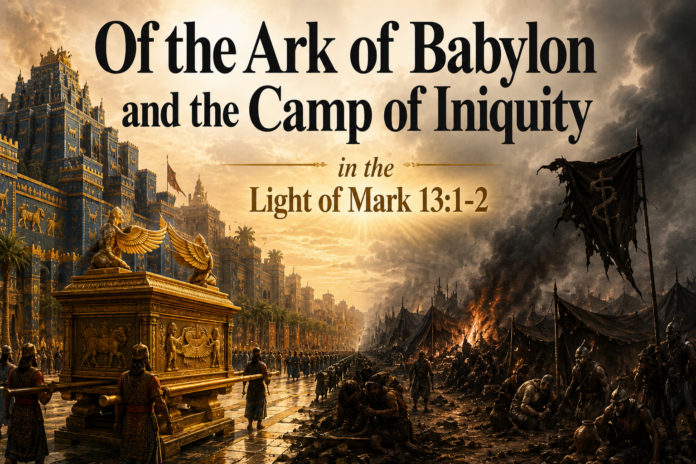
As a watchman on my watch over what I perceive as the building of the Ark of Babylon, the expanding Camp of Iniquity, the Mountain of Murderers, and the Citadel of Hypocrisy, the Spirit of the Lord brought to my remembrance the warning and prophecy of our Lord Jesus Christ in Mark 13:1–2:
“Do you see these great buildings?” replied Jesus. “Not one stone here will be left on another; every one will be thrown down.”
As I meditated on these words, I was reminded of the futility of every human enterprise that is not founded upon the righteousness, truth, and purposes of God.
However magnificent or enduring such works may appear, they remain temporary before the sovereign judgment of God.
When Jesus spoke these words, His disciples were captivated by the grandeur of the Jerusalem Temple.
They admired its impressive architecture, but Jesus redirected their attention from the temporary to the eternal.
He reminded them that even the most magnificent human achievement is subject to decay and judgment.
This passage has caused me to examine some of the priorities of the contemporary Church.
Across many nations, enormous resources are devoted to constructing increasingly larger and more elaborate church auditoriums.
While there is nothing inherently wrong with building places where God’s people can gather for worship, discipleship, and ministry, there is a danger when the beauty of the building begins to overshadow the beauty of holy living.
A magnificent sanctuary is not necessarily evidence of a healthy Church. Marble floors, towering cathedrals, sophisticated sound systems, and architectural excellence cannot replace repentance, righteousness, compassion, justice, humility, and obedience to Christ. God has always desired a people whose hearts belong to Him more than monuments built in His name.
History reminds us that many once-famous places of worship now stand empty, have become museums, or have disappeared altogether. Buildings come and go, but the Church that Christ is building consists of living people who have been redeemed by His grace. The true temple of God is His people, among whom His Spirit dwells.
The Church must therefore continually ask difficult but necessary questions.
Are we investing as much in making disciples as we are in erecting buildings?
Are we as passionate about raising godly families as we are about fundraising?
Are we measuring success by attendance and architecture, or by transformed lives and faithful obedience to Christ?
Mark 13:1–2 reminds me that everything visible is temporary. The works that endure are those built on Christ and accomplished for His glory. Every earthly structure, regardless of its size or beauty, has an expiration date. God’s kingdom alone is everlasting.
My prayer is not that the Church should stop building buildings, but that we never mistake buildings for the Kingdom itself.
May our greatest investment always be in people rather than property, in character rather than comfort, in discipleship rather than display, and in the advancement of God’s Kingdom rather than the celebration of human achievement.
This is my personal meditation on the words of Jesus in Mark 13:1–2. It is not a condemnation of church buildings themselves, but a call to examine whether our priorities reflect the heart of Christ. When every earthly monument has faded away, only what has been built according to God’s will and for His glory will endure.
Courtesy: Heal the Church Outreach ( HECO) Ministry